Bridesmaid Hairstyles: Coordinated Ideas That Flatter Every Person in Your Party
Bridesmaid hairstyles: coordinated ideas for different hair types, who pays, and how to keep the party looking cohesive.

by Sarah Glasbergen on 12 April 2026
Web editor
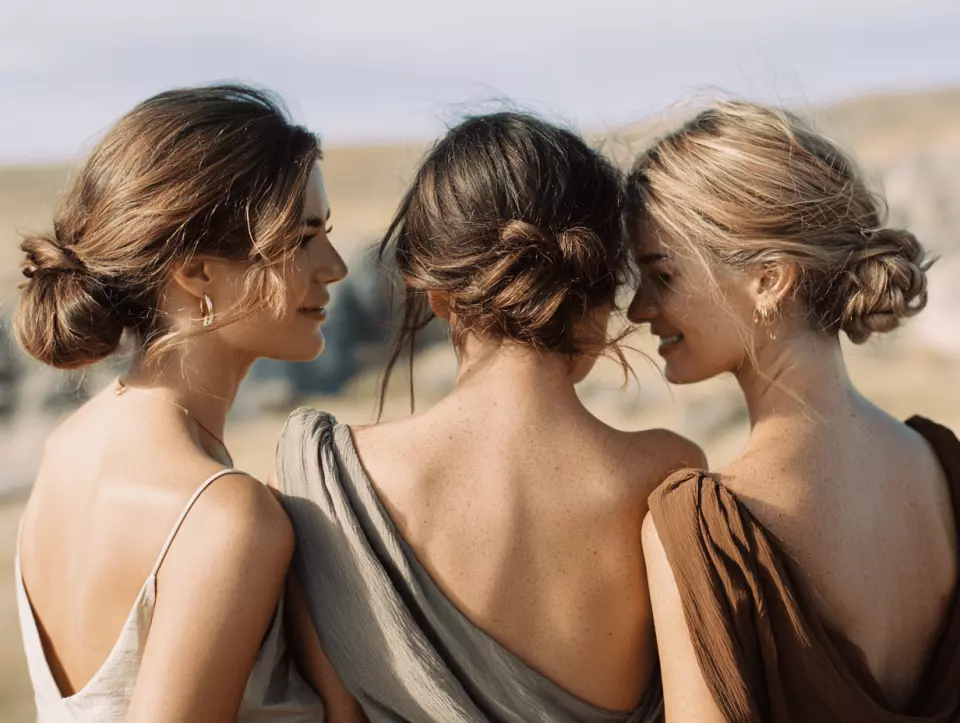
TLDR: Bridesmaid hairstyles should be coordinated but not identical, allowing each person to wear a style that flatters their face shape, hair type, and personal comfort. The modern approach: choose a general direction (all up, all down, all half-up) and let each bridesmaid pick the specific variation that works best for them. ThePerfectWedding.com's beauty experts share the best coordinated looks, how to handle different hair types and lengths in the same party, and how to keep the overall aesthetic cohesive without being matchy-matchy.
Key Facts at a Glance
- The average bridal party has 4 to 6 bridesmaids (Source: The Knot, 2025)
- Bridesmaid hair styling costs $75 to $150 per person for professional on-location service (Source: WeddingWire)
- Coordinated, not matching is the #1 bridal party hair trend (Source: Brides.com)
- 70% of brides let bridesmaids choose their own style within a general direction (Source: Zola)
- Coordinate outfits with our mismatched bridesmaid styling guide on ThePerfectWedding.com
The 3 Best Approaches to Bridesmaid Hair
Same direction, different execution
The most popular and most flattering approach. Choose one direction: all updos, all half-up, or all down. Then each bridesmaid picks the specific variation that works for their hair. One bridesmaid does a low chignon, another a textured bun, another a braided updo. All are updos. All look coordinated. All flatter the individual. This approach handles different hair lengths, textures, and face shapes gracefully.
Matching accessory, individual styles
Give every bridesmaid the same hair accessory (matching pins, a coordinating clip, or a simple fresh flower) and let them style their hair however they want. The accessory creates visual cohesion across very different hairstyles. This is the most relaxed approach and the easiest for bridal parties with widely different hair types. See our hair accessories guide for matching options.
Fully matching
Every bridesmaid wears the exact same hairstyle. This creates the most uniform, editorial look in photos. It works best when all bridesmaids have similar hair length and texture. If your party includes short and long hair, curly and straight, this approach becomes difficult and can look forced. Best for formal, classic weddings where uniformity is part of the aesthetic.
Best Coordinated Styles by Direction

All updos
The most formal and most practical option (hair stays off necks in summer heat, survives wind, shows off dress details). Options within this direction: classic chignon, romantic low bun, braided updo, textured top knot. Each bridesmaid picks what flatters them. All photograph beautifully together because the overall silhouette (hair up, necks visible) is consistent.
All half-up
The most versatile and universally flattering direction. Works with every hair type and length. Options: twisted half-up, braided half-up, volume half-up with curls, sleek half-up with a ponytail. The visible portion (face framing) looks coordinated in photos while the bottom section can be straight, wavy, or curly based on natural texture.
All down
The most relaxed and romantic direction. Works best for casual, outdoor, and bohemian weddings. Options: Hollywood waves, soft curls, textured beach waves, sleek blowout. Be aware that "all down" requires more product and touch-ups to keep everyone looking fresh, and wind can be a factor outdoors.

Handling Different Hair Types in One Party
Short hair + long hair: A bob bridesmaid can do a pinned-back style or faux updo while long-haired bridesmaids do a full updo. The overall direction (up) stays consistent even though the techniques differ.
Straight + curly hair: Do not force the curly-haired bridesmaid to straighten or the straight-haired bridesmaid to curl. A half-up direction lets the curly bridesmaid show her natural texture in the bottom section while the straight-haired bridesmaid wears waves. Both are half-up. Both look beautiful. Both look like themselves.
Thick + fine hair: The same style looks different on thick vs. fine hair, and that is OK. A low bun on thick hair is voluminous and dramatic. On fine hair, it is delicate and sleek. Both are beautiful. Do not try to make fine hair look thick or vice versa. Work with what each person has.
Who Pays for Bridesmaid Hair?
Option 1: Bride pays. This is generous and ensures everyone gets professional styling. Budget $75 to $150 per person plus travel and early start fees. Include this in your beauty budget. See our bridal hair cost guide for full pricing.
Option 2: Each bridesmaid pays. This is common and acceptable. Give bridesmaids the choice to opt in or opt out of professional styling. Those who opt out can DIY their hair in the same general direction.
Option 3: Bride pays for styling, bridesmaids pay for trials. A middle ground that covers the wedding-day cost while allowing bridesmaids who want to test their style to pay for their own trial appointment.
Whatever you decide, communicate it early. Bridesmaid costs add up (dress, shoes, travel, gifts, bachelorette). Being transparent about hair costs prevents financial surprises and resentment.
Expert Tip: "The bridal parties that look best in photos are not the ones where everyone has the exact same hairstyle. They are the ones where everyone looks like a more polished version of themselves. Give your bridesmaids a direction, not a dictation. 'I would love everyone in some form of updo' gives structure with freedom. 'Everyone must have this exact low bun' creates frustration for the bridesmaid whose hair does not cooperate."
Sarah Glasbergen, Founder at ThePerfectWedding.com

Frequently Asked Questions
Should bridesmaids match the bride's hairstyle?
No. The bride's style should stand out, not be duplicated. The bride might wear an elaborate updo while bridesmaids wear simpler versions. Or the bride wears hair down with a veil while bridesmaids wear half-up. The bride is distinguished by her dress, veil, and accessories, not by having the same hairstyle as everyone else.
Can bridesmaids wear their hair however they want?
Some brides prefer this relaxed approach, and it works well for casual and bohemian weddings. For more formal or photo-focused weddings, a general direction (up/down/half) creates better visual cohesion in group photos. Giving gentle guidance is not controlling. It is thoughtful.
What if a bridesmaid hates the suggested style?
Listen. If she is uncomfortable, it will show in photos. Find a compromise that stays within your general direction but accommodates her concern. If she hates updos because they give her a headache, a loose half-up might be the answer.
Should junior bridesmaids and flower girls match?
A simplified version of the bridesmaid direction works well: a simple half-up with a ribbon or small flower for younger members. Keep it age-appropriate, comfortable, and easy to maintain without constant adult attention.
Coordinate Your Bridal Party on ThePerfectWedding.com
Browse all bridal hairstyles on our bridal hairstyles page. Coordinate outfits with our mismatched bridesmaid styling guide and browse bridesmaid ideas. Choose from updos, half-up, braids, or down styles. Add matching accessories or flowers. Budget with our hair cost guide and our wedding cost overview. Find stylists for your full party on our vendor directory. Match your palette on our color guide.


