Wedding DJ vs. Live Band: Cost, Vibe, and How to Choose the Right Entertainment
Wedding DJ vs. live band: cost comparison, pros and cons, hybrid options, and questions to ask.

by Sarah Glasbergen on 18 April 2026
Web editor
TLDR: The DJ vs. band decision shapes the entire energy of your reception. A DJ offers versatility, lower cost, and guaranteed songs. A live band offers raw energy, visual spectacle, and a concert-like atmosphere. ThePerfectWedding.com's entertainment experts compare cost, pros, cons, and the questions to ask so you choose the right fit for your reception, your budget, and your crowd.
Key Facts at a Glance
- Average DJ cost: $1,000 to $2,500 for 4 to 6 hours (Source: The Knot, 2025)
- Average live band cost: $3,000 to $8,000+ for a 4 to 5 piece band (Source: WeddingWire)
- 75% of US weddings use a DJ. 20% use a live band. 5% use both or neither (Source: Brides.com)
- The #1 factor in guest satisfaction with reception entertainment: a full dance floor, regardless of DJ or band (Source: Zola)
- Find DJs and bands on our music page on ThePerfectWedding.com
The DJ
Pros
Versatility: A DJ can play any genre, any era, any artist, any song. From 1960s Motown to today's pop hits, the full catalog is available. No arrangement needed. No rehearsal required. If a guest requests a song, the DJ plays the original.
Cost: A quality DJ costs $1,000 to $2,500, roughly one-third the cost of a live band. For budget-conscious couples, this frees up $2,000 to $5,000 for other priorities.
Reliability: One person, one setup, one sound. DJs are logistically simpler: less space, less power, faster setup and teardown. Fewer moving parts means fewer things that can go wrong.
MC services: Most DJs double as emcees, announcing the first dance, speeches, bouquet toss, and other reception moments. A band typically does not MC.
Cons
Lower visual energy: A DJ behind a laptop is not a visual spectacle. What you gain in musical range, you lose in stage presence. Good DJs compensate with lighting, movement, and audience interaction, but they are one person vs. a full stage of performers.
Quality varies wildly: The gap between a great DJ and a terrible one is enormous. A bad DJ plays the wrong songs, talks too much, reads the room poorly, and kills the energy. Interview thoroughly and check references.
Best for
Couples who want musical variety across genres, a lower budget, MC services included, and a guaranteed version of every song. Also best for smaller venues where a full band would be too loud or too large.
The Live Band
Pros
Energy: Nothing matches the raw energy of live musicians. A full band on stage creates a concert atmosphere that a laptop cannot replicate. Guests feed off the performers' energy, and the dance floor stays packed.
Visual spectacle: A 5 to 10 piece band with a vocalist is a performance, not background music. The visual impact of live instruments, coordinated outfits, and stage presence elevates the reception from party to event.
Unique sound: Live music has warmth, imperfection, and spontaneity that recorded music lacks. Songs sound different live than on a recording. That uniqueness makes the music memorable.
Cons
Cost: A quality wedding band costs $3,000 to $8,000+ for a 4 to 6 hour reception. This is often the single largest entertainment expense and can strain the budget.
Limited repertoire: A band knows 50 to 150 songs. They cannot play every request. If a guest wants a specific niche song, the band may not know it. Some bands learn 5 to 10 custom requests for an additional fee.
Space and logistics: A band needs more floor space (stage area), more power outlets, and more setup time. In small venues, the band can overpower the room acoustically and physically.
Sound consistency: Live performance is inherently variable. Some sets are electric. Others are flat. The band's energy depends on the crowd's energy, the acoustics, and the night.
Best for
Couples who want high energy, a concert atmosphere, visual spectacle, and have the budget. Best for larger venues (150+ guests) where the band can fill the space without overwhelming it.

The Hybrid Option
DJ + live musicians
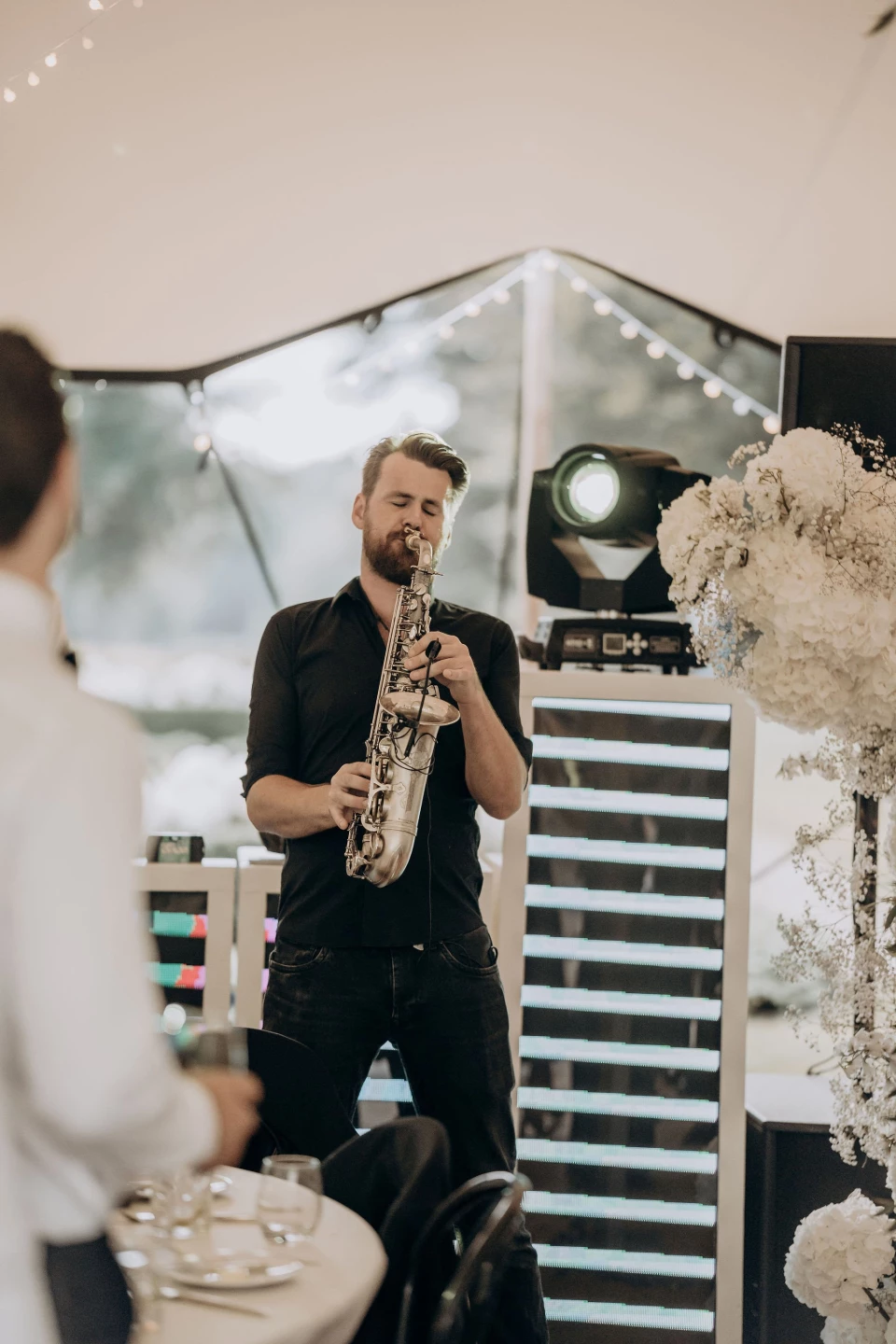
A DJ plays recorded music while live musicians perform alongside: a saxophonist over dance tracks, a percussionist adding live beats, or a vocalist singing over DJ-mixed instrumentals. This combines the DJ's versatility with live energy. Cost: $2,000 to $4,000. Increasingly popular at modern weddings.
Band for part, DJ for part
The band performs the first 2 to 3 hours (dinner, first dance, parent dances) and the DJ takes over for late-night dancing. This gives you both experiences and lets the band play their best material during the prime hours. Cost: $3,500 to $6,000 combined.
Questions to Ask During Consultations
For DJs
- Can I hear a sample mix or see video of a recent wedding?
- How do you read the crowd and adjust the playlist?
- Do you take requests from guests? How do you handle inappropriate requests?
- Will YOU personally DJ our wedding or will you send an associate?
- What equipment do you bring? Backup equipment?
- Do you provide MC services, lighting, or both?
For bands
- Can I see you perform live at another event or showcase?
- What is your song list? Can you learn our first dance song?
- How many breaks do you take and what happens during breaks (recorded music)?
- What is your setup and sound check timeline?
- Do you bring your own sound engineer?
- What is the cancellation and substitution policy if a member is sick?
Expert Tip: "The question is not 'DJ or band?' The question is 'what do we want the dance floor to feel like?' If you want every single guest singing along to the exact version of their favorite song, hire a DJ. If you want the room vibrating with live energy and guests feeling like they are at a private concert, hire a band. Both fill dance floors. They just do it differently."
Sarah Glasbergen, Founder at ThePerfectWedding.com

Frequently Asked Questions
Can a DJ create the same energy as a band?
A great DJ can, yes. Energy comes from song selection, timing, crowd reading, and volume management, not just the source of the music. A skilled DJ who reads the room perfectly can create a dance floor just as packed as a live band. A mediocre DJ or a mediocre band will both result in empty floors.
Do bands take breaks?
Yes, typically 15 to 20 minutes every hour. During breaks, the band plays pre-recorded music through their sound system. Some couples use breaks for speeches, cake cutting, or other reception events to maintain flow. Discuss break timing with the bandleader.
Can I provide a "do not play" list?
Absolutely, and you should. Give your DJ or band a list of 5 to 10 songs you never want to hear at your wedding. "Chicken Dance," "Macarena," or any song that carries negative associations. Most entertainment professionals welcome this guidance.
Is it worth paying more for a well-known DJ or band?
Experience and reputation matter more than fame. A DJ with 500+ weddings reads a room better than a DJ with 20. A band that performs 50 weddings a year knows how to pace an evening. Pay for experience and reviews, not name recognition. Check references and see them perform live before booking. See our vendor contracts guide.
More Music Guides on ThePerfectWedding.com
See our first dance songs, ceremony music, parent dance songs, entrance songs, reception playlist, and last dance songs. Compare costs with our cost guide and negotiation guide. Plan with our day-of timeline. Find DJs and bands on our music page and vendor directory.


