Wedding Cakes with Pearls: Elegant, Classic, and Luxurious Details
Wedding cakes with pearls: sugar pearls, cascading strands, encrusted tiers, and design ideas. Elegant guide

by Sarah Glasbergen on 17 April 2026
Web editor
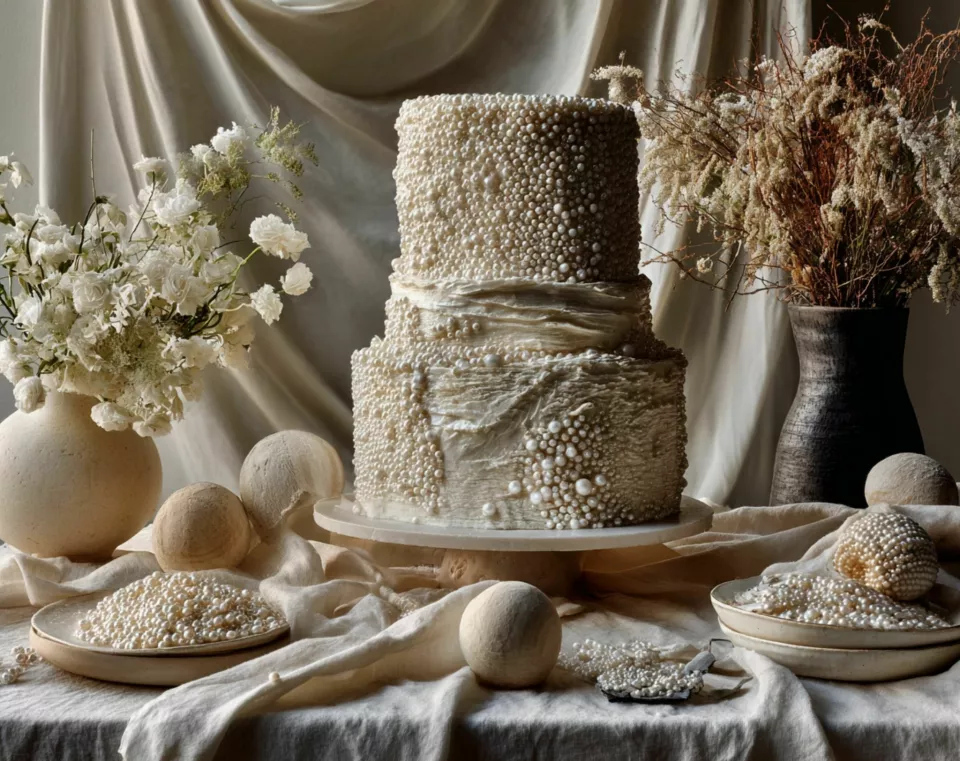
TLDR: Pearl details on a wedding cake add timeless elegance, luxurious texture, and a dimensional quality that flat frosting cannot match. From delicate sugar pearl borders to dramatic cascading pearl strands and full pearl-encrusted tiers, pearls are one of the most versatile and beautiful cake accents. ThePerfectWedding.com's cake experts share the types of pearls used on cakes, how they are applied, and the design styles that showcase them best.
Key Facts at a Glance
- Pearl details are the #2 most popular non-floral cake decoration after metallics (Source: The Knot, 2025)
- Pearl accents add $50 to $300 to the cake cost depending on coverage (Source: WeddingWire)
- Edible sugar pearls are food-safe and entirely edible, though most guests do not eat them individually (Source: Brides.com)
- Pearl cakes have surged 120% in popularity over the past 2 years, driven by the "quiet luxury" trend (Source: Zola)
- Browse all cake styles on our wedding cakes page on ThePerfectWedding.com
Types of Pearls on Wedding Cakes
Sugar pearls
The most common cake pearl. Small, round sugar balls in white, ivory, gold, silver, or colored finishes. Available in sizes from tiny (2mm) to large (10mm+). Sugar pearls are food-safe, edible, and easy for bakers to apply. They can be placed individually with tweezers or applied in lines, clusters, and patterns.
Fondant pearls
Hand-rolled fondant balls shaped and sized by the baker. Fondant pearls allow custom sizing and can be made in any color. They are softer than sugar pearls and mold to the cake surface slightly. Best for vintage and classic cake designs.
Royal icing pearls
Tiny dots of piped royal icing that dry hard and resemble pearls. The most traditional method, used in classic British wedding cakes for centuries. Royal icing pearls are perfectly uniform when piped by a skilled baker and add delicate, refined detail.
Dragees (metallic sugar balls)
Silver or gold metallic-coated sugar pearls. Dramatic and glamorous. Dragees are technically edible but very hard. They add metallic luxury to cake borders and accents. Best used sparingly as accent rather than full coverage.
Pearl Design Ideas
Pearl border
A single row of pearls at the base of each tier. The simplest and most classic pearl application. Adds a finished, polished edge to any cake design. Works with every cake style from minimalist to vintage.
Cascading pearl strand
Pearls arranged to look like a necklace or strand draped down the side of the cake. Dramatic, luxurious, and editorial. The pearls follow a curved path down one or more tiers. This design is having a major moment on social media.
Full pearl encrusted tier
One entire tier covered in pearls. The most dramatic pearl application. Usually the middle tier is fully encrusted while the top and bottom tiers are smooth, creating contrast. This technique is labor-intensive (hundreds of pearls placed individually) and adds significant cost.
Pearl clusters
Groups of pearls of varying sizes clustered together in a few strategic spots. Organic and modern rather than structured. Pearl clusters combined with fresh flowers or greenery create a dimensional, textured effect.
Pearl and lace combination
Piped or fondant lace patterns accented with pearls at intersections and focal points. The most traditional and elaborate pearl cake design. Best for vintage-inspired and formal wedding cakes.
Scattered pearls
Pearls of different sizes scattered randomly across the cake surface. Whimsical, modern, and effortless-looking. The scattered approach feels less structured and more contemporary than borders or strands.
Pearl Color and Finish Options
Classic white: Timeless, traditional, and universally beautiful. White pearls on a white cake create a monochromatic texture.
Ivory or cream: Warmer than white. Matches ivory frosting for a cohesive, soft look.
Gold: Luxurious and warm. Gold pearls add glamour without overwhelming. Best on white or ivory cakes for contrast.
Silver: Cool and modern. Silver pearls suit winter and formal cakes.
Mixed sizes: Combining 2mm, 4mm, and 8mm pearls creates depth and visual interest. The size variation looks more natural and dimensional than uniform sizing.
Pairing Pearls with Other Cake Elements
Pearls + fresh flowers: One of the most beautiful combinations. Pearls add texture between or around flower placements. The contrast of organic flowers and geometric pearls creates visual richness.
Pearls + metallic accents: Gold leaf with gold pearls, or silver dust with silver dragees. The metallic-pearl combination is peak luxury.
Pearls + textured buttercream: Pearls on a textured buttercream cake add dimension to already-dimensional frosting. The pearls catch light that the texture creates.
Pearls + minimalist design: A smooth, clean cake with nothing but a pearl border or scattered pearls. The pearls become the only decoration, and simplicity makes them more impactful.
Expert Tip: "Pearls are having their biggest moment in wedding cake design right now, and I understand why. They add a luxury quality that no other detail achieves. A smooth white cake with a cascade of sugar pearls down one side looks like a Chanel couture piece. It is quiet luxury applied to dessert. The key: choose one pearl design element and commit. A pearl border OR a cascading strand OR scattered clusters. Not all three. Let the pearls breathe."
Sarah Glasbergen, Founder at ThePerfectWedding.com
Frequently Asked Questions
Are cake pearls edible?
Sugar pearls and fondant pearls are fully edible and food-safe. Metallic dragees are technically edible but very hard. Most guests eat around the pearls rather than chewing them individually. Your baker should confirm that all pearl elements are food-safe.
How much do pearl details add to the cost?
Simple pearl border: $50 to $100. Cascading strand or scattered pearls: $100 to $200. Full pearl-encrusted tier: $200 to $400+. The cost reflects the labor of placing hundreds of individual pearls by hand.
Can I add pearls to a buttercream cake?
Yes. Sugar pearls adhere to buttercream naturally. Your baker presses them gently into the frosting while it is still soft. On chilled buttercream, a tiny dot of piping gel helps pearls stick. Pearls work on every frosting type including ganache and cream cheese. No fondant needed.
Will pearls fall off during transport?
Properly applied pearls should not fall off. Bakers secure them into the frosting or attach them with food-safe adhesive (piping gel). For very elaborate pearl designs, bakers may apply pearls at the venue after cake delivery and setup.
Explore More Cake Styles on ThePerfectWedding.com
Browse all cakes on our wedding cakes page. Combine pearls with fresh flowers, fruit, or metallic accents. See styles: modern, minimalist, vintage, boho, naked. No fondant: buttercream only. Sizes: one-tier, two-tier, three-tier. Season: fall, winter. Find bakers on our vendor directory.


