Outdoor Ceremony Seating Guide: Layouts, Chair Options, and How to Make 150 Guests Comfortable on Grass
Outdoor ceremony seating: layouts, chair types for grass, sun orientation, accessibility, and comfort strategies for every guest.

by Sarah Glasbergen on 23 June 2026
Web editor
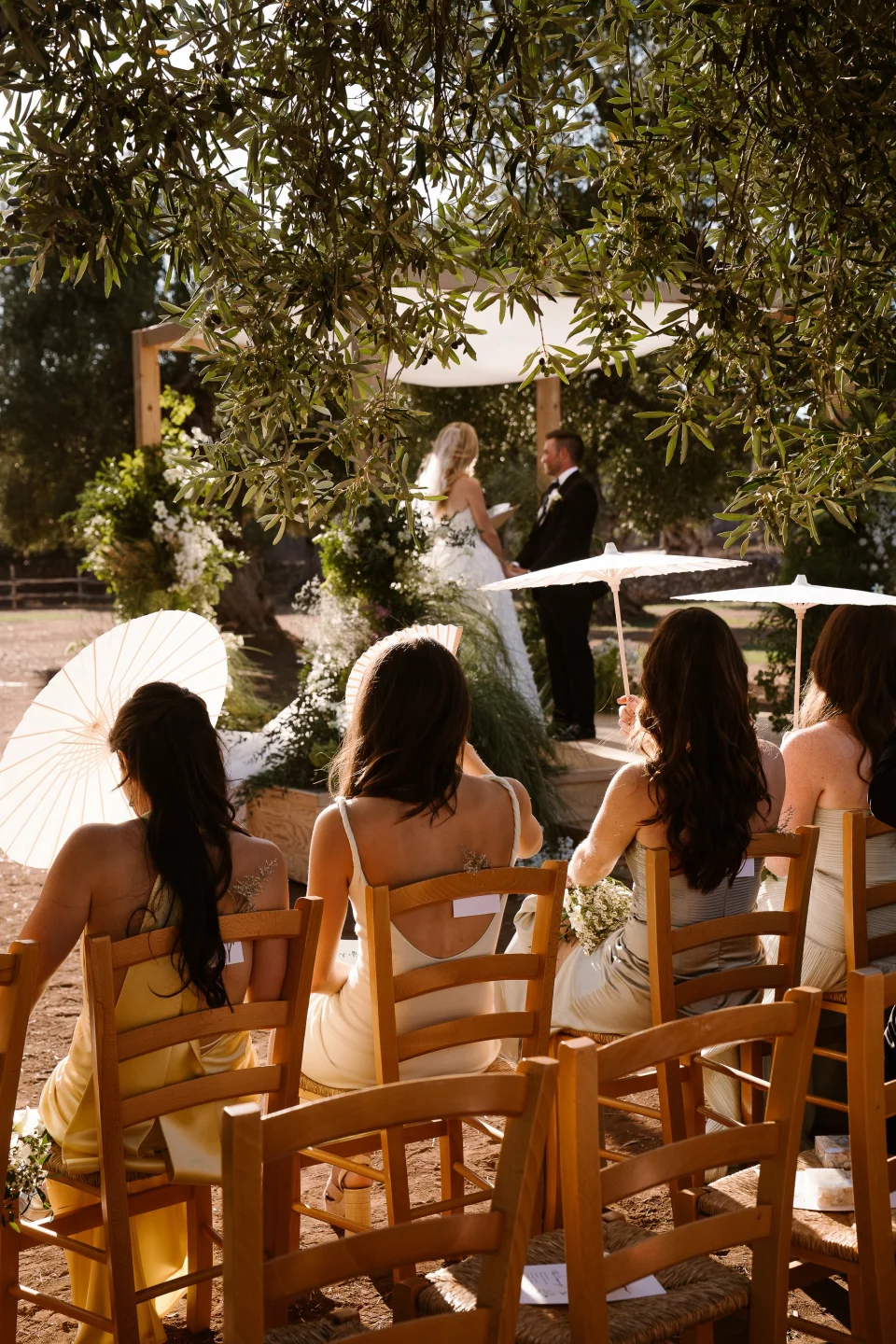
TLDR: Outdoor ceremony seating involves challenges that indoor ceremonies never face: uneven ground, sun angles, wind, grass stains on white chairs, sinking chair legs, and the fundamental question of whether your guests can actually see and hear you from every seat. ThePerfectWedding.com's event experts cover every layout option, the chair types that work (and those that do not) on outdoor surfaces, sun and shade management, accessibility considerations, and the practical details that make the difference between a comfortable, beautiful ceremony and one where your grandmother is squinting into the sun from a wobbly chair sinking into soft ground.
Key Facts at a Glance
- Outdoor ceremony chair rental: $3 to $15 per chair depending on style, from basic folding to elegant crossback (Source: The Knot, 2025)
- 8 square feet per guest is the minimum for ceremony seating in rows with a center aisle (Source: WeddingWire)
- Sun orientation matters: guests should never face directly into the sun during the ceremony (Source: Brides.com)
- Uneven ground requires chair leveling or platform installation for safety and comfort (Source: Zola)
- See our creative seating chart ideas for reception layout inspiration and our venue capacity guide for space calculations

Ceremony Layout Options
Traditional rows with center aisle
The most common and most practical outdoor ceremony layout. Two sections of chairs separated by a 5 to 6 foot wide center aisle. The couple stands at the front, facing the guests, with the officiant behind them (or between them, facing the guests). This layout is familiar to every guest, easy to set up on any terrain, and works for any guest count from 30 to 300+. Rows should be 3 to 4 feet deep (chair depth plus legroom) with 18 to 24 inches between chairs in the same row. For 150 guests in this layout, you need approximately 1,200 square feet of flat ground (15 rows of 10 chairs, each row 8 feet wide on each side of the aisle). The aisle should be straight, even, and clearly defined, whether with a runner, petals, or simply the gap between chair sections.
Semicircle or curved rows
Chairs arranged in concentric arcs wrapping around the ceremony focal point. This layout creates a sense of intimacy because every guest is angled toward the couple rather than looking straight ahead. It works beautifully for ceremonies in natural amphitheater settings (a hillside, a clearing surrounded by trees, or a curve of shoreline) and for smaller weddings (under 100 guests) where the wrap-around arrangement brings everyone closer. The tradeoff: curved rows are harder to set up evenly on grass, require more space than straight rows for the same guest count, and can create odd sightlines in the back rows where guests at the ends see mostly the backs of other guests' heads. For this layout to work, the curves should be gentle (not tight semicircles) and the rows should not exceed 7 to 8 deep.
In-the-round (circular seating)
Guests surround the couple in a full or three-quarter circle. The couple stands in the center, and the ceremony happens with guests on all sides. This creates the most intimate, communal feeling of any layout because no guest is more than 4 to 5 rows from the couple. It also eliminates the traditional "bride's side and groom's side" division, which modern couples increasingly prefer. The tradeoffs: the couple has their back to some guests at all times, the processional path is shorter and less dramatic, and photography angles are limited because the photographer cannot shoot from the front without being in the ceremony circle. Best for weddings under 80 guests where intimacy is more important than processional drama.
No assigned seating (standing ceremony)
Guests stand in a loose gathering around the ceremony spot. This works for very short ceremonies (under 10 minutes, such as intimate backyard elopement-style celebrations) with a small, young, able-bodied guest list. It does not work for traditional-length ceremonies (20 to 30 minutes), for groups that include elderly guests or guests with mobility limitations, or for hot-weather events where standing in the sun creates discomfort and medical risk. If you choose standing, still provide 10 to 15 chairs at the front for elderly guests, pregnant guests, and anyone who needs to sit.
Chair Types for Outdoor Surfaces
Chairs that work on grass
Folding chairs with wide, flat feet (the classic white resin folding chair at $3 to $5/rental) distribute weight and sink less into soft ground. Crossback or vineyard chairs ($8 to $15/rental) are heavier and more stable, with broader leg bases that resist sinking. Wooden farm chairs ($6 to $12/rental) are sturdy and rustic-appropriate for barn and garden venues. For any chair on grass, push each chair firmly into the ground during setup to create a stable base rather than letting it settle gradually under guest weight. If the ground is soft from recent rain, place plywood squares (12 by 12 inches) under each chair's front legs to prevent sinking. This is tedious setup work but prevents wobbling and tipping during the ceremony.
Chairs that struggle on grass
Chiavari chairs (the classic gold or silver banquet chair) have narrow, pointed feet that sink into grass and become unstable. They are designed for hard, flat indoor surfaces. Using Chiavari chairs outdoors on grass requires foot caps or pads ($0.50 to $1 per chair additional) to widen the contact point. Even with caps, they are less stable than chairs designed for outdoor use. Ghost chairs (transparent acrylic) are stylish but heavy, slippery on wet grass, and uncomfortable in direct sun (the acrylic heats up significantly). Reserve these for indoor receptions or tented events with flooring.
Sun, Shade, and Weather Comfort
Sun orientation is non-negotiable
Determine the sun's position at your ceremony time and orient seating so guests face AWAY from the sun. If the ceremony is at 4 PM and the sun is in the west, guests should face east (sun behind them) and the couple faces west (sun behind the guests, illuminating the couple's faces for photography). Guests squinting into direct sunlight for 20 to 30 minutes will be miserable, and every candid photo will show squinting, grimacing faces. This single orientation decision affects guest comfort more than any other seating choice. Check the sun angle for your specific date and time using a sun position calculator (sunearthtools.com) and walk the ceremony site at that exact time during your site visit.
Shade strategies
If shade from existing trees does not cover the ceremony area: parasols at each seat ($3 to $8 each, doubles as a favor), a shade sail or canopy over the guest area ($500 to $2,000), or simply scheduling the ceremony after 4 PM when the sun is lower and less intense. For summer ceremonies before 4 PM, shade is not optional, it is a guest safety requirement. Heat-related illness is a real risk at outdoor events, especially for elderly guests. Provide water bottles or a water station accessible before and during the ceremony, not just at the cocktail hour after. See our hot weather wedding tips.
Wind considerations
Wind affects programs, lightweight chair cushions, aisle runners, and hair. For windy venues (beaches, rooftops, hilltops), skip paper programs (they blow away and litter the site), secure the aisle runner with stakes or weights at both ends and along the edges, weigh down any lightweight decor, and brief your wedding party about wind-resistant hairstyles. If consistent wind is expected, orient seating so the wind blows from behind the guests toward the couple, not the reverse (wind in guests' faces for 25 minutes creates the same misery as sun in their eyes).

Accessibility
Wheelchair and mobility access
At least one aisle must be wide enough for a wheelchair (minimum 36 inches, ideally 48 inches). The path from parking or the main venue to the ceremony seating area must be navigable for wheelchairs, walkers, and guests with limited mobility. Grass is not wheelchair-accessible when soft. Gravel is difficult for walkers and canes. Solutions: temporary pathway mats or boardwalk sections over grass ($200 to $500), a firm-ground route identified and marked, and designated accessible seating positions (end of a row on firm ground, not in the middle of a row requiring the guest to navigate past other guests' legs). Ask during the site visit: "What is the accessible path from arrival to ceremony seating?"
Reserved front-row seating
Reserve the front 1 to 2 rows on each side for immediate family and any guests who need proximity to see and hear clearly. This includes elderly guests with hearing or vision limitations, guests who are hard of hearing (closer to the sound system speakers), and any guests whose comfort requires minimal walking. Mark reserved seats with a small "Reserved" sign or ribbon rather than leaving it to chance. Ushers should guide reserved-seat guests to their positions before general seating begins.
Expert Tip: "Walk every single row of your ceremony seating the afternoon before the wedding and sit in the farthest seat from the ceremony spot. Can you see? Can you hear? Is the sun in your eyes? Is the ground level? Is the chair stable? That seat, the worst seat in your ceremony, determines the minimum experience for your guests. If that seat is uncomfortable, fix the problem. Move the layout. Add a speaker. Adjust the orientation. Every guest deserves to see your vows and hear your words clearly, not just the front three rows."
Sarah Glasbergen, Founder at ThePerfectWedding.com

Frequently Asked Questions
How many chairs should we order?
Order your confirmed guest count plus 5% to 10% extra. For 150 confirmed guests, order 158 to 165 chairs. The extras cover last-minute additions, plus-ones who were not in the original count, and replacements for any chairs that are damaged, dirty, or unstable. Extra chairs cost $3 to $15 each. Not having enough chairs is an unsolvable day-of problem.
Should we have a bride's side and groom's side?
This tradition is increasingly optional. "Pick a seat, not a side" signs are common and popular, especially when one partner has significantly more guests than the other (preventing an awkwardly empty section) or for second marriages and blended families where guests know both partners. If you prefer traditional sides, have ushers guide guests. If you prefer open seating, a clear sign at the aisle entrance eliminates confusion.
Do we need an aisle runner outdoors?
On grass: optional and often problematic. Runners on grass bunch up, blow in the wind, and create tripping hazards. The green grass itself is a beautiful natural aisle. On sand (beach ceremonies): skip the runner entirely because it will not lay flat. On gravel or dirt: a runner or temporary flooring improves walkability for heels. On a hard surface (patio, deck): a runner adds elegance without the stability issues of soft ground.
What about ceremony seating for a beach wedding?
Beach ceremony seating has unique challenges. Standard chair legs sink into sand. Solutions: use chairs with wide, flat bases, place plywood boards under each chair (hidden by sand), or use low benches that distribute weight across a larger surface. Keep guest seating above the high-tide line and check tide tables for your ceremony time. Consider a shorter ceremony (15 minutes maximum) to limit time sitting on potentially hot, sun-exposed seats. See our beach wedding guide for full details.
How do we handle seating if it starts to rain?
If your outdoor ceremony has an indoor backup, move everything inside. If the backup is a tent, confirm that the tent has adequate space for your ceremony layout. If no backup exists and light rain begins: provide umbrellas (a basket of clear umbrellas at the entrance), shorten the ceremony to essentials, and embrace the moment. Heavy rain: postpone by 30 to 60 minutes if the forecast shows it passing, or move to your backup location. See our complete rain plan guide.
More outdoor wedding planning on ThePerfectWedding.com: Tent weddings, Sound guide, Lighting guide, Hot weather tips, Cold weather guide, Bug prevention, and more. See our weather backup plan guide and indoor vs outdoor comparison. Browse outdoor venue types: barn, vineyard, beach, and garden estate. Find venues on our venue directory.


