Which Side Do You Sit On at a Wedding? Seating Guide
Which side do you sit on at a wedding? Traditional Christian and Jewish seating sides explained, plus the modern pick a seat not a side approach.

by Sarah Glasbergen on 30 June 2026
Web editor
In short
Traditionally, which side you sit on at a wedding depends on whether you are a guest of the partner getting married on that side, and it differs between Christian and Jewish ceremonies. But the modern norm is simple: many couples now invite guests to pick a seat, not a side, so everyone mixes together.
Below we cover the traditional seating sides, how they flip for different ceremonies, where the wedding party and family sit, and the popular pick a seat approach.
It is the small question every guest quietly asks at the back of a ceremony: left or right? The answer is part tradition, part etiquette, and increasingly, totally up to you.
Key Facts at a Glance
- In a traditional Christian ceremony, the bride's guests sit on the left and the groom's on the right, facing the altar.
- In a traditional Jewish ceremony, the sides are reversed, with the bride's side on the right and the groom's on the left.
- The front rows are reserved for immediate family, with parents and grandparents seated closest to the couple.
- The pick a seat, not a side approach is now widely popular, inviting guests to sit anywhere so the two families mix.
- 2026 couples favor relaxed, personal touches over rigid formality, which fuels the open seating trend (Source: The Knot Worldwide 2026 Real Weddings Study).
- A simple sign or usher makes seating effortless, telling guests exactly what to do as they arrive.
Which side do you sit on at a wedding?
The classic rule is about whose guest you are. Facing the altar in a traditional Christian ceremony, the bride's family and friends sit on the left, and the groom's sit on the right. The idea dates back to customs that placed each partner on a particular side.
According to ThePerfectWedding.com's ceremony etiquette guidance, this is a guideline rooted in tradition rather than a fixed rule. Plenty of modern couples keep it, adapt it, or drop it entirely, and guests increasingly look for a sign or usher to tell them what this particular couple prefers.
How the sides change for different ceremonies
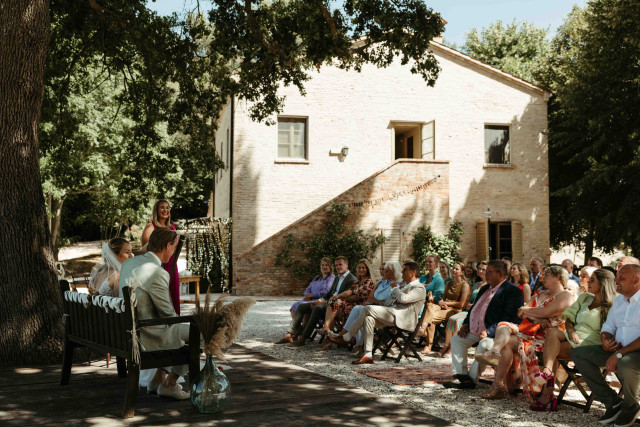
The biggest source of confusion is that the sides are not universal. The traditional Christian arrangement is reversed in a Jewish ceremony, and other traditions and cultures have their own conventions, which is exactly why a clear sign helps so much.
| Ceremony type | Bride's side | Groom's side |
|---|---|---|
| Traditional Christian | Left, facing the altar | Right, facing the altar |
| Traditional Jewish | Right, facing the altar | Left, facing the altar |
| Modern pick a seat | Either side, guests mix freely | Either side, guests mix freely |
If you are blending traditions, or simply do not want guests worrying about it, the open seating approach sidesteps the whole question. The key is to communicate clearly, since guests genuinely do not want to sit in the wrong spot.
Where do the wedding party and family sit?
Regardless of the side convention, the front rows are reserved for the people closest to the couple. Immediate family, parents, and grandparents take the first one or two rows, traditionally on their own partner's side.
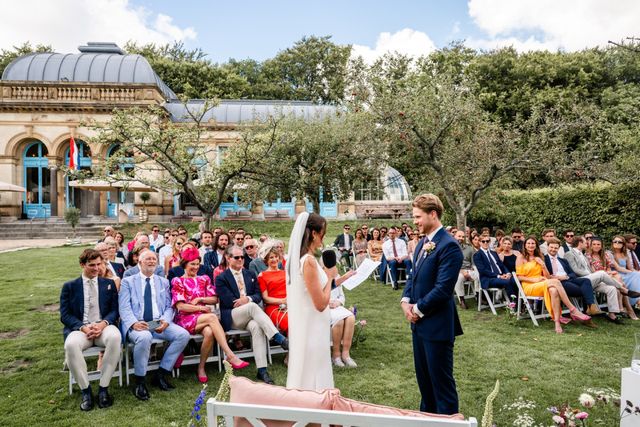
The wedding party usually stands with the couple at the altar rather than sitting, though in some setups they take reserved front row seats once they have walked in. Mark reserved rows clearly with signs or ribbons so guests know not to take those seats.
The modern pick a seat, not a side approach
The most popular modern choice is to ditch the divide entirely. A sign reading pick a seat, not a side, you are loved by both the bride and groom, invites everyone to sit wherever they like, mixing the two families together.
Couples love it for a few reasons. It avoids a lopsided room when one partner has more guests, it symbolizes two families becoming one, and it takes the pressure off guests who do not know whose side they belong on. It is relaxed, inclusive, and very on trend for 2026.
There is also a practical photography angle. A balanced, full looking ceremony space simply photographs better than a room that is packed on one side and sparse on the other. Whether you mix everyone together or even out the sides with a quiet word to your ushers, an evenly filled room gives your photographer clean, symmetrical wide shots of the ceremony, the kind you will want enlarged later. It is a small thing that makes a visible difference in the final gallery, and it costs nothing but a moment of forethought, and your guests will never know it was anything but effortless.
How to tell guests where to sit
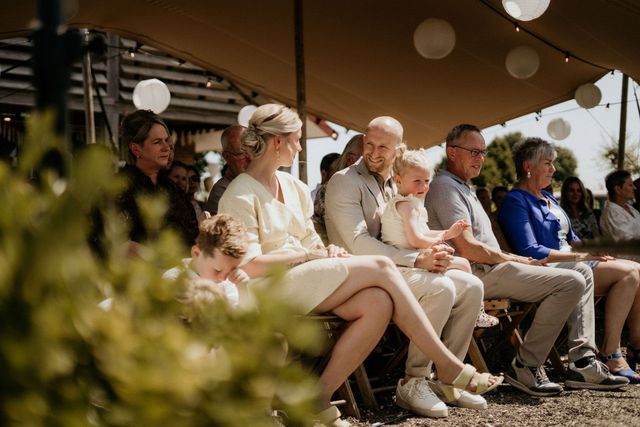
Whatever you decide, the single most important thing is telling your guests clearly, because a confused guest hovering at the back is the one avoidable hiccup of ceremony seating. You have a few easy ways to do it:
- A seating sign at the entrance, stating your preference in a line or two.
- Ushers or wedding party members who greet guests and guide them to a seat.
- A note in the ceremony program, if you are having one.
- Reserved signs or ribbons on the front rows for close family.
- A quick brief to your coordinator so the team knows the plan before doors open.
If you are keeping traditional sides, an usher asking which side a guest belongs to, or a small sign at each end, does the job. If you are going open, a single cheerful sign reading pick a seat, not a side removes all doubt in one sentence.
For larger weddings, consider gently steering the balance. If one partner has far more guests, ushers can quietly fill both sides evenly so the room looks full and symmetrical in your photos. The goal is a space that fills smoothly and looks intentional from the very first frame, and a few minutes of planning gets you there.
Common mistakes to avoid
- Assuming the sides are universal. They flip between Christian and Jewish ceremonies, so never assume without checking the couple's setup.
- Not telling guests your preference. Whether you keep sides or go open, a sign or usher prevents confusion at the back.
- Forgetting to reserve family rows. Mark the front rows clearly so close family always has a seat.
- Letting one side look empty. If guest numbers are uneven, open seating keeps the room looking full and balanced.
- Overcomplicating it. A single clear sign does the job. Guests just want to know where to go.
The seating sides are a lovely tradition, but they are not a test. Whether you keep the old rule or simply ask everyone to pick a seat, the only thing guests really need is a clear, warm sign telling them what you would like.
Sarah Glasbergen, Founder at ThePerfectWedding.com
Frequently asked questions about wedding ceremony seating
-
Which side does the bride's family sit on?
In a traditional Christian ceremony, the bride's family and guests sit on the left when facing the altar, and the groom's sit on the right.
-
Are the sides different for a Jewish wedding?
Yes. In a traditional Jewish ceremony the sides are reversed, with the bride's side on the right and the groom's side on the left, facing the altar.
-
Where do parents sit at a wedding ceremony?
Immediate family, including parents and grandparents, sit in the front one or two rows, traditionally on their own partner's side, in reserved seats.
-
What does pick a seat, not a side mean?
It is a modern, open seating approach where guests are invited to sit anywhere rather than by side, so the two families mix together freely.
-
Why do couples choose open seating?
It avoids a lopsided room when guest numbers are uneven, symbolizes two families uniting, and removes the pressure on guests who do not know which side to choose.
-
How do guests know which side to sit on?
Through a clear sign at the entrance or an usher who guides them. Without one, guests are left guessing, so communication is key.
-
Does the wedding party sit during the ceremony?
Usually they stand with the couple at the altar, though in some setups they take reserved front row seats after walking in.
-
What if one partner has far more guests?
Open seating is the easy fix, since it keeps the room balanced and full rather than leaving one side looking empty.
Plan a ceremony that flows
Smart seating is just one piece of a smooth ceremony. Use the wedding planning checklist on ThePerfectWedding.com to organize your ceremony, signage, and guest experience from start to finish.


