How to Write Your Own Wedding Vows: A Step-by-Step Guide for Every Couple
How to write wedding vows: step-by-step process, what to include, delivery tips, and examples.

by Sarah Glasbergen on 18 April 2026
Web editor
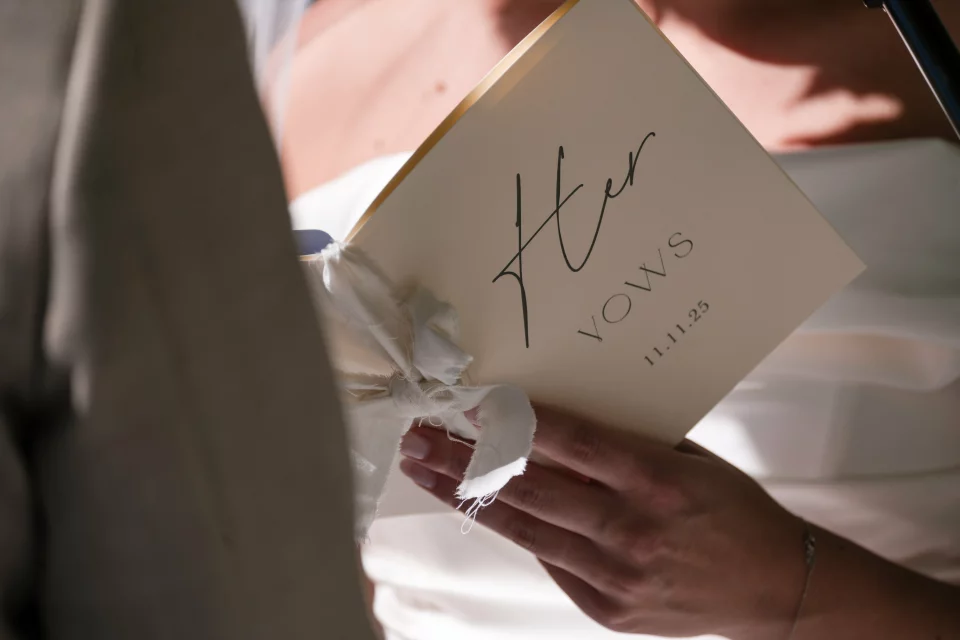
TLDR: Writing personal wedding vows is one of the most meaningful, terrifying, and rewarding parts of getting married. Your vows are promises spoken aloud in front of the people you love, and they become the emotional centerpiece of the ceremony. ThePerfectWedding.com's ceremony experts walk you through the step-by-step process: what to include, how long to make them, how to find the right words when you are not a writer, and how to deliver them without dissolving into a puddle of tears.
Key Facts at a Glance
- 55% of US couples now write their own vows, up from 30% a decade ago (Source: The Knot, 2025)
- Ideal vow length: 1 to 2 minutes per person (approximately 150 to 300 words) (Source: Speechy)
- Start writing vows 4 to 6 weeks before the wedding to allow time for reflection and revision (Source: WeddingWire)
- The #1 vow-writing mistake: starting too late and panicking the week before (Source: Brides.com)
- See our ceremony readings guide for additional ceremony content on ThePerfectWedding.com

The Step-by-Step Process
Step 1: Decide together on the format
Before writing independently, agree on the basics with your partner: Will you both write personal vows, or use traditional vows with personal additions? How long should each set of vows be? (Agree on a range so they match in length.) Should they be humorous, serious, or a mix? Will you share them with each other before the ceremony, or hear them for the first time at the altar?
Step 2: Brainstorm without editing
Set a timer for 20 minutes and write freely about your partner. Do not edit. Do not judge. Just write answers to these prompts:
- When did you know you loved this person?
- What is the one quality in them you admire most?
- What specific moment changed your relationship?
- What are you most excited about for your future together?
- What promises do you want to make?
- How has this person changed you for the better?
This raw material becomes the foundation of your vows.

Step 3: Find your structure
Most personal vows follow a three-part structure:
Part 1: The story (30 to 60 seconds). One specific memory or moment that captures your love. Not a timeline of your relationship. One moment, told vividly.
Part 2: What they mean to you (30 to 60 seconds). Who this person is and what they bring to your life. Specific qualities, specific impacts.
Part 3: The promises (30 to 60 seconds). What you vow to do, be, and give in this marriage. These are the actual vows: forward-looking commitments spoken with intention.
Step 4: Write the first draft
Using your brainstorm and the three-part structure, write a complete first draft. Do not aim for perfection. Aim for honesty. The first draft will be too long and too unfocused. That is normal. The editing comes next.
Step 5: Edit ruthlessly
Cut to 150 to 300 words. Remove anything generic ("you are my best friend" unless you follow it with something specific). Remove anything that sounds like a greeting card. Keep only the lines that make you feel something when you read them aloud. If a sentence does not add emotion or specificity, delete it.
Step 6: Practice out loud
Read your vows out loud at least 5 times. Standing up. At full voice. Time yourself. You will discover which words feel awkward, where the natural pauses fall, and which parts make you cry (plan for those). Practice does not make the emotion disappear. It makes you capable of speaking through it.
What to Include
One specific memory
"The night you drove three hours in a rainstorm to bring me soup when I was sick, and then fell asleep on my couch because you were too tired to drive back." Specific memories are the backbone of great vows. They show, not tell. They are uniquely yours.
One genuine quality
"You are the person who remembers everyone's birthday, who checks on friends nobody else thinks to check on, and who makes every room you walk into a little bit warmer." Name a quality and then prove it with evidence. "You are kind" is generic. "You are kind, and I know this because..." is a vow.
Real promises
"I promise to always be your safe place. I promise to listen even when I think I already know the answer. I promise to choose us, every day, even when choosing is hard." Promises should be actionable and honest, not aspirational poetry. "I promise to love you forever" is a wish. "I promise to show up for you, even on the days when showing up is difficult" is a vow.

What to Avoid
Inside jokes nobody understands
Your vows are spoken in front of an audience. If a reference only makes sense to the two of you, save it for the private letter and choose something the room can follow. One small inside reference is fine if you provide enough context. Five inside jokes in a row alienates your guests.
Negativity about the past
Do not mention exes, past failures, or dark periods unless the growth from them is the explicit point. Vows are forward-looking. "Before you, I was broken" puts the emphasis on brokenness. "With you, I discovered a version of myself I am proud of" puts the emphasis on growth.
Pressure to be funny
If you are naturally funny, humor in vows works beautifully. If you are not naturally funny, do not force jokes. Sincere vows that make people cry are more powerful than mediocre jokes that get polite laughter. Know your strengths. Write to them.
Being too long
Anything over 2 minutes per person starts to lose the audience. Brevity intensifies emotion. The most powerful vows are often the shortest. Say less, mean more.
Delivery Tips
Write them on nice paper or a vow book
Do not read from your phone. Print your vows on quality paper or write them in a small vow booklet that becomes a keepsake. Vow books are available for $10 to $30 and look beautiful in photos.
Memorize or read?
Read. Memorizing creates enormous pressure and the risk of blanking at the most emotional moment of your life. Reading from a vow book is expected, normal, and practical. You will make natural eye contact between lines.
Manage the tears
You will cry. Your partner will cry. Pause. Breathe. Look at your partner. Continue. The officiant can hand you a tissue. The audience will wait. Crying during vows is not a failure. It is the most authentic moment of the entire day.
Speak slowly
Adrenaline speeds you up. Consciously speak 30% slower than normal. Your guests need to hear and absorb each word. The pauses between sentences are where the emotion lands. Do not rush through the most important words you will ever say.
Expert Tip: "The best vows I have ever witnessed were 90 seconds long. The groom looked at the bride and said: 'When I met you, I thought I knew what I wanted from life. I was wrong. What I wanted was you. What I want is this. Every morning, every evening, every ordinary Tuesday for the rest of my life.' That was it. The room was in tears. Ninety seconds. You do not need 5 minutes. You need 5 honest sentences."
Sarah Glasbergen, Founder at ThePerfectWedding.com

Frequently Asked Questions
Do our vows need to match in length?
Approximately, yes. If one partner speaks for 30 seconds and the other for 4 minutes, the imbalance is noticeable and uncomfortable. Agree on a target (1 to 2 minutes each) and share word counts before the wedding to ensure rough parity.
Can we use traditional vows with personal additions?
Yes, and this is a beautiful hybrid approach. Start with traditional vows ("I take you to be my [husband/wife/partner]...") and follow with a personal addition ("And I also promise you this: [personal vow]"). This satisfies families who value tradition while adding personal meaning.
Should we share vows with each other before the ceremony?
Personal preference. Sharing prevents mismatched tones (one funny, one serious). Not sharing preserves the surprise and emotional impact. A middle ground: share vows with the officiant or a trusted friend who can flag any issues without spoiling the surprise.
What if we are not good writers?
You do not need to be a writer. You need to be honest. "I love you because you always save me the last piece of pizza" is better writing than any polished poem because it is real. Specificity and honesty are more important than eloquence. See our readings guide for additional ceremony inspiration.
More Ceremony Guides on ThePerfectWedding.com
See our ceremony readings, unity ceremony ideas, processional order, and how to choose an officiant. Plan a secular ceremony or interfaith ceremony. Create your ceremony program. Coordinate with our day-of timeline and planning checklist. Find officiants on our vendor directory.


