How to Choose a Wedding DJ: What Separates Great DJs from the Rest
Wedding DJ guide: what DJs actually do, consultation questions, DJ vs live band, music planning, cost breakdown, and red flags.

by Sarah Glasbergen on 30 June 2026
Web editor
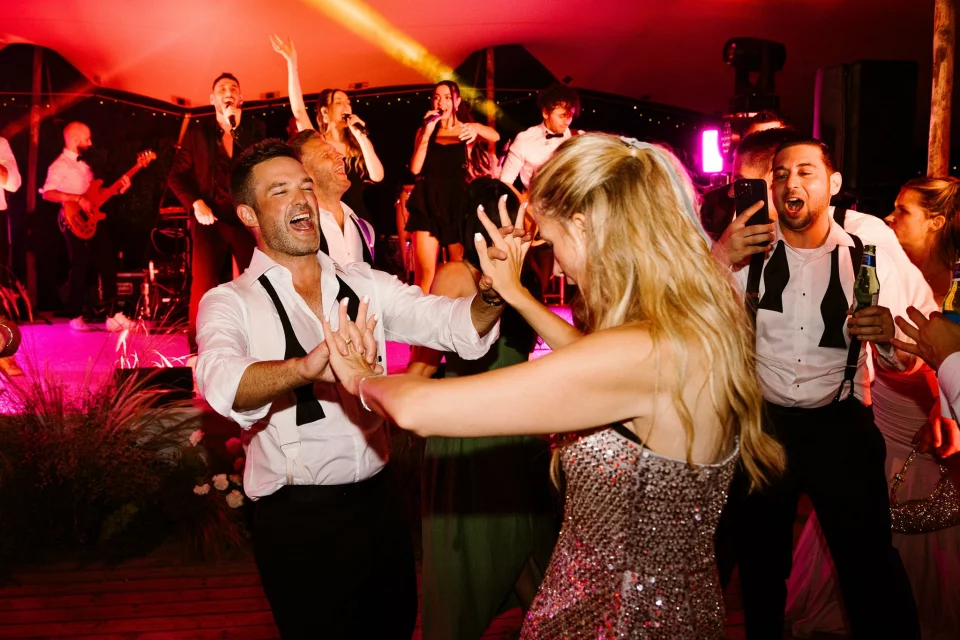
TLDR: Your DJ is not just the person who plays music. Your DJ is the energy manager of your entire reception, the MC who controls the flow of the evening, and the professional who reads 150 people's mood in real time and adjusts accordingly. A great DJ fills the dance floor from the first song to the last. A mediocre DJ empties it. ThePerfectWedding.com's entertainment experts explain what separates an exceptional wedding DJ from one who just presses play, the questions that reveal quality during consultations, and the red flags that predict a disappointing dance floor.
Key Facts at a Glance
- Average US wedding DJ cost: $1,000 to $2,500 for 4 to 6 hours of reception coverage including MC services (Source: The Knot, 2025)
- The DJ is rated as the #1 factor in whether guests describe a reception as "fun" or "boring" (Source: WeddingWire)
- Book 6 to 9 months ahead for peak-season Saturdays. Top-rated DJs fill their calendar quickly (Source: Brides.com)
- A DJ who also MCs saves you from hiring a separate emcee and ensures seamless transitions between moments (Source: Zola)
- Find DJs on our wedding DJ directory
What a Wedding DJ Actually Does
Playing music is 30% of a wedding DJ's job. The other 70% is invisible but essential:
- MC duties: introducing the couple, announcing the first dance, cueing speeches, directing the bouquet toss, managing transitions between reception phases. The MC voice sets the tone: warm and professional, not cheesy game-show-host
- Energy management: reading the room minute by minute. Are guests sitting down? Switch to a crowd-moving song. Is the dance floor packed? Keep the energy building. Are older guests leaving? Transition to slower songs that keep the remaining crowd happy. This is an art that separates professionals from amateurs
- Timeline coordination: working with the coordinator to ensure every reception moment happens on schedule. The DJ cues the cake cutting, the speeches, the last dance, and the exit. Timing is everything
- Sound management: adjusting volume for different moments (quiet during dinner, louder during dancing, moderate during speeches), ensuring microphones work for speakers, and preventing feedback or audio problems
- Atmosphere creation: setting background music during cocktail hour and dinner that matches the vibe without overpowering conversation, then building energy progressively as the evening transitions to dancing
Questions to Ask During the DJ Consultation
Experience and style
- "How many weddings have you DJ'd?" Look for 50+ weddings minimum. Wedding DJing is a specific skill that club and party DJs do not automatically possess
- "Can I see a video of you performing at a recent wedding?" Photos show equipment. Video shows energy, MC style, crowd interaction, and how full the dance floor gets
- "What is your MC style?" Some DJs are energetic and enthusiastic (great for party-focused receptions). Others are warm and understated (great for elegant, intimate events). Neither is wrong, but the style must match your wedding vibe
- "How do you handle music requests from guests?" The right answer: they take requests but filter them through the couple's preferences and the do-not-play list. Wrong answer: they play whatever anyone asks for regardless of your wishes
Logistics and equipment
- "What equipment do you bring?" Professional speakers, subwoofer, wireless microphones (minimum 2 for speeches), backup equipment, and laptop/controller with a music library of 10,000+ songs. Ask about uplighting as an add-on ($300 to $800)
- "Do you have backup equipment?" A professional DJ carries a backup laptop, backup speakers, and backup microphones. Equipment failure with no backup means silence at your reception
- "What is your setup and teardown time?" DJs typically need 1 to 2 hours for setup and 1 hour for teardown. Factor this into your venue rental timeline. See our timeline template
- "Will you visit the venue before the wedding?" A DJ who knows the room's acoustics, power outlet locations, and layout in advance delivers better sound than one who walks in blind on the day
Planning and coordination
- "How do we plan the music?" The best DJs offer a planning meeting 4 to 6 weeks before the wedding where you finalize the must-play list, do-not-play list, special songs (first dance, parent dances, processional), and the overall vibe for each reception phase
- "Will you coordinate with our coordinator and photographer?" The DJ, coordinator, and photographer must align on timing. The DJ should be willing to take cues from the coordinator and hold transitions until the photographer is in position
- "What happens if you cannot make it?" A professional DJ has a network of trusted colleagues who can substitute. The backup should be someone of equivalent quality, and you should have approval rights
DJ vs. Live Band: The Honest Comparison
- DJ advantages: wider music variety (can play any genre, any era, any artist), lower cost ($1,000 to $2,500 vs. $3,000 to $10,000 for a band), more flexible volume control, guaranteed sound quality (recorded tracks vs. live interpretation), and built-in MC services
- Band advantages: live energy that recordings cannot replicate, visual spectacle (a 6-piece band on stage is entertainment in itself), unique arrangements and covers that personalize familiar songs, and a premium, event-level atmosphere
- Hybrid option: hire a DJ for the full evening and a live musician (solo guitarist, jazz trio, string quartet) for the ceremony and cocktail hour. This gives you live music where it matters most and DJ versatility for the dance floor. Cost: $1,500 to $4,000 total
- ThePerfectWedding.com recommendation: if your budget allows one or the other, a skilled DJ delivers more consistent results for the reception dance floor. If your budget allows both, the ceremony + cocktail live music / DJ reception hybrid is the best of both worlds
What to Include in Your Music Planning
The must-play list
Songs you absolutely want played at specific moments:
- Ceremony: processional song (walking down the aisle), recessional song (walking back as married)
- First dance: the song is the memory. Choose carefully and tell your DJ in advance so they can prepare any special edits (fade-out timing, intro skip)
- Parent dances: father/daughter, mother/son, or any combination. One song each
- Cake cutting music: a fun, short song that plays during the cutting
- Last dance: the final song before the exit. This becomes a sentimental moment, so choose something meaningful
- 5 to 15 must-play songs: the songs that will get YOUR specific crowd on the dance floor. Do not rely on generic crowd-pleasers. Think about what YOUR friends and family dance to at parties
The do-not-play list
Songs you explicitly do NOT want played, regardless of guest requests:
- Songs associated with an ex-partner or a painful memory
- Songs you find inappropriate for your event or guest list
- Specific genres you dislike ("no country" or "no heavy metal")
- Overplayed wedding songs you find cringeworthy ("Chicken Dance," "Macarena," "YMCA" are common do-not-plays)
- Any song that your families have specifically asked you NOT to play (family sensitivities exist)
The do-not-play list is as important as the must-play list. A single unwanted song can sour the mood for the couple even if the rest of the night is perfect. Professional DJs respect the do-not-play list without exception.
Cost Breakdown
- $800 to $1,200 (budget): experienced DJ, 4 hours, basic sound system, MC services. Good for smaller weddings (under 100 guests) with straightforward reception formats
- $1,200 to $2,000 (mid-range): experienced DJ, 5 to 6 hours, professional sound system, wireless mics for speeches, MC services, planning meeting. The sweet spot for most weddings
- $2,000 to $3,500 (premium): top-rated DJ, 6 to 8 hours, premium sound, uplighting, intelligent lighting, multiple wireless mics, extensive planning, possibly a second DJ or MC. For large weddings (200+) or couples who prioritize entertainment
- Add-ons: uplighting ($300 to $800), dance floor lighting ($200 to $500), ceremony sound ($150 to $300), cocktail hour background music ($100 to $200). See our hidden costs guide for the full entertainment budget

Expert Tip: "I have attended hundreds of weddings, and the single biggest difference between a reception guests call 'the best wedding I have ever been to' and one they politely describe as 'lovely' is the DJ. Not the flowers. Not the food. Not the venue. The DJ. A great DJ fills the dance floor within 3 songs of the first dance and keeps it packed until midnight. A mediocre DJ plays great music to an empty dance floor because they cannot read the room, time the transitions, or build energy progressively. When you are allocating your entertainment budget, invest in the DJ who has 100+ wedding references and a video showing a packed dance floor. That video is worth more than any portfolio of equipment photos."
Sarah Glasbergen, Founder at ThePerfectWedding.com
Frequently Asked Questions
Should we create a detailed playlist or let the DJ choose?
Neither extreme works well. A 200-song playlist leaves no room for the DJ to read the room and adapt. No playlist at all risks the DJ playing music that does not match your taste. The ideal approach: a must-play list of 10 to 20 songs, a do-not-play list of 10 to 20 songs, and a general vibe description ("90s R&B and current pop" or "classic rock and Motown") that gives the DJ creative direction while allowing real-time adaptation.
How do we keep the dance floor full?
This is primarily the DJ's skill, but you can help: choose a first dance song that transitions naturally into an upbeat crowd song (the DJ should have this planned). Invite the wedding party to hit the floor immediately after the first dance. Ensure the bar stays open during dancing (guests leave the floor when the bar closes). Keep the dinner-to-dancing transition tight (no 30-minute gap). And trust your DJ to build energy progressively rather than front-loading all the hits. See our timeline template for reception pacing.
Is it worth paying more for a premium DJ?
For the reception, yes. The DJ controls 3 to 4 hours of your guests' experience. A $500 price difference between a good DJ and a great DJ affects every minute of the reception. Compare this to other wedding expenses where a $500 difference has minimal guest impact. The DJ is the highest-ROI entertainment investment you can make. Find top-rated DJs on our DJ directory.
Can we have both a DJ and a live musician?
Yes, and this is increasingly popular. A live musician (acoustic guitarist, jazz trio, string quartet) for the ceremony and cocktail hour provides elegant, atmospheric live music. The DJ takes over for the reception, providing the sound system, MC services, and dance floor energy. This combination costs $1,500 to $4,000 total and delivers the best of both worlds.
More entertainment guides on ThePerfectWedding.com. See our wedding timeline, planning checklist, and hidden costs guide. Find DJs on our DJ directory.


