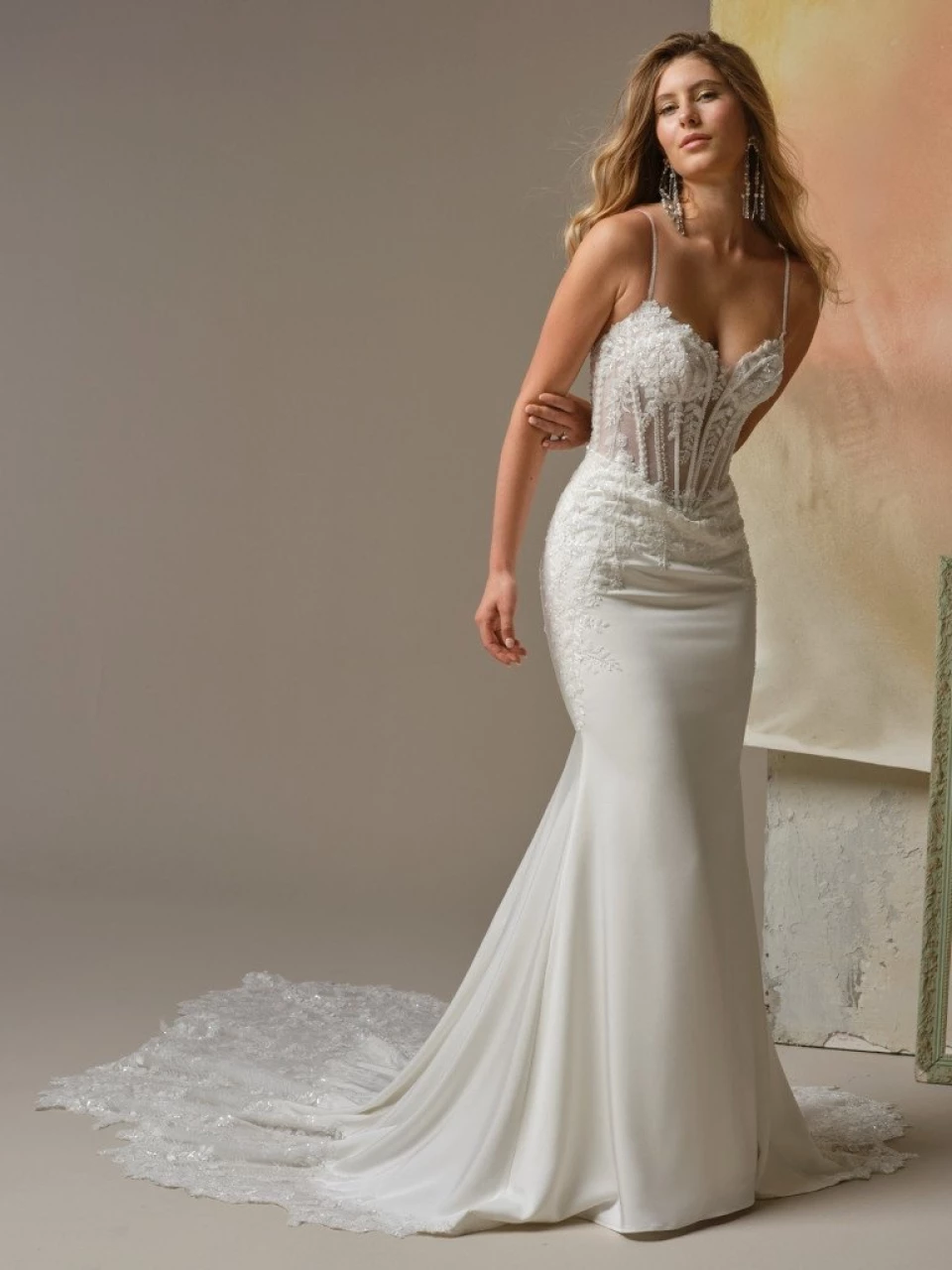
Wedding Dresses for Petite Brides: Styles That Flatter Your Frame
Wedding dresses for petite brides: silhouettes and necklines that elongate, train and veil lengths, petite sizing, hemming, shoes and boutique tips.

by Sarah Glasbergen on 18 November 2026
Web editor

TLDR: The best wedding dresses for petite brides create a long, unbroken vertical line. Sheath, A-line, empire and trumpet silhouettes with a defined or slightly raised waist work beautifully, as do V-necks, sweetheart and off-the-shoulder necklines. Keep trains, veils and embellishments in proportion to your frame, and plan on a precise hem. Petite sizes, a skilled seamstress and the right shoes make any style work. This guide covers silhouettes, necklines, train and veil lengths, alterations, shoes and boutique tips.
By Sarah Glasbergen, Founder ThePerfectWedding.com. Updated November 2026
Key Facts at a Glance
- Average height: the average US woman aged 20 and over is 63.5 inches tall, about 5 feet 3.5 inches (Source: CDC National Center for Health Statistics, 2023)
- Petite cut: petite wedding dresses at David's Bridal have skirts 3 inches shorter and bodices 1 inch shorter than standard sizes (Source: David's Bridal, 2026)
- Hemming: hemming a wedding dress usually costs $125 to $450 (Source: The Knot, 2025)
- Dress budget: the average wedding dress costs about $2,100 (Source: The Knot Real Weddings Study, 2026)
- Shop around: brides visit an average of 2.5 bridal salons before buying (Source: The Knot Wedding Attire Study, 2018)
Being petite does not limit your options; it just means proportions matter. With the average American woman standing at about 5 feet 3.5 inches, petite brides are hardly rare, and bridal designers have plenty of styles cut with them in mind. Here is how to find the one that feels made for you.


What counts as a petite bride?
In fashion, petite usually means 5 feet 4 inches and under. It is about height and proportion, not size: petite brides can wear any dress size, and petite plus sizes exist too. Some taller brides with a shorter torso also find petite cuts fit better through the bodice.
Petite dresses are proportioned differently, with a shorter bodice, higher waist placement, smaller armholes and a shorter skirt. That means less fabric to remove during alterations and a better fit from the start.
Which wedding dress silhouettes flatter petite brides?
The goal is a long, clean line from shoulder to floor. Silhouettes that define the waist or keep volume controlled tend to work best, while very heavy, full skirts can overwhelm a smaller frame.
| Silhouette or neckline | Why it works for petite brides | Watch out for |
|---|---|---|
| Sheath or column | An unbroken vertical line adds visual height | Clingy fabrics show every line |
| A-line | Defines the waist and flows without bulk | Choose light layers over heavy tulle |
| Empire waist | A raised waistline makes legs look longer | Can look young in heavy fabric |
| Trumpet | Shows shape with a higher flare point | Keep the train modest |
| Ball gown | Possible in light tulle with a fitted bodice | Very full skirts can overwhelm |
| V-neck | Draws the eye up and down, lengthening the torso | Adjust depth for support |
| Sweetheart or off-the-shoulder | Shows the collarbones and shoulders | Needs a precise bodice fit |
| High neck | Elegant on brides with a longer neck | Can shorten a shorter torso |
ThePerfectWedding.com recommends trying at least one style outside your comfort zone. Many petite brides are surprised how well a soft A-line works; see our A-line wedding dress guide.


Which necklines make petite brides look taller?
Necklines that open up the chest and shoulders create the illusion of a longer torso. A V-neck is the classic choice, because it draws the eye vertically. Sweetheart, plunging, scoop and off-the-shoulder necklines also add length by showing more skin around the collarbones.
- Most elongating: V-neck, deep V and plunging illusion necklines.
- Balanced options: sweetheart, scoop and off-the-shoulder.
- Use with care: high necks, heavy collars and wide bateau necklines can shorten the upper body.
- Sleeves: sheer or slim sleeves keep the look light; avoid very puffy sleeves unless they are scaled down.
Compare every option in our wedding dress necklines guide.

How long should the train and veil be for a petite bride?
Trains and veils add drama, but scale matters. A very long, heavy train can make a petite bride look swallowed by the dress, while a modest train keeps the focus on you.
- Trains: sweep and court trains are easy to manage; a chapel train works for a formal ceremony.
- Cathedral trains and veils: possible if the fabric is light, such as sheer tulle with a thin edge.
- Veils: fingertip and waltz lengths flatter most petite brides; a sheer cathedral veil works if it is very light.
- Placement: placing the veil comb higher on the head adds a little height.
Read our guides to the wedding dress with train and how to choose a wedding veil for every length.


Should petite brides buy a petite size or hem a standard dress?
Both work. A petite size is cut with a shorter bodice and skirt, so it usually needs fewer alterations. A standard dress can be hemmed and taken in by a skilled seamstress, but removing a lot of length can affect lace borders, beading and the shape of the train.
- Ask your consultant whether the designer offers petite or custom lengths.
- Check how far the hem has to come up; lace edges and horsehair hems are trickier to shorten.
- Ask whether the waistline can be raised if the bodice is too long.
- Start alterations a few months before the wedding and plan for two to three fittings.
A hem usually costs $125 to $450, according to The Knot. See the full schedule in our guide to wedding dress alterations cost and timeline.
What shoes should petite brides wear with their wedding dress?
Shoes change the hem length, so choose them before your first fitting. Heels add height and help a long gown fall correctly, but comfort matters just as much, because you will be standing, walking and dancing for hours.
- Block heels: stable on grass, gravel and stairs, with a little added height.
- Platforms: extra height without a steep angle; hidden under a floor-length gown.
- Pointed toes: visually lengthen the leg, especially with a shorter or tea-length dress.
- Nude or skin-tone shoes: extend the line of the leg in a short dress.
- Two pairs: one for the ceremony and a comfortable pair for dancing, both of the same height.
Find more options in our wedding shoes guide.

Which fabrics and details work best for petite brides?
Lightweight fabrics and scaled details keep the look in proportion. A delicate lace with small motifs reads more elegantly on a petite frame than oversized appliqués or heavy, stiff fabrics.
- Light fabrics: crepe, chiffon, soft tulle and fine lace move well and avoid bulk.
- Vertical details: princess seams, vertical lace panels and a slit create length.
- Scaled embellishment: fine beading and small motifs instead of large 3D flowers.
- Tonal belts: a slim belt in the same shade defines the waist without cutting the body in half.
How should petite brides shop at a bridal boutique?
A bridal boutique is the best place to see how different cuts work on your frame. Consultants know which designers offer petite sizing and can pin samples to show you how a dress will look after alterations.
- Mention your height when you book so the boutique can pull petite-friendly samples.
- Bring heels close to the height you plan to wear.
- Ask the consultant to pin the hem and bodice so you see the real proportions.
- Try a sheath, an A-line and one wildcard style.
- Ask about in-house alterations and timelines before you buy.
- Take photos from a distance in the mirror; proportions are easier to judge from a few steps back.
According to ThePerfectWedding.com's shopping advice, a sample that looks too long on the hanger can be perfect once it is pinned, so do not rule anything out too quickly.


“Petite brides can wear almost any silhouette, as long as the proportions are right. Look for a long, clean line, keep the details delicate and invest in a great hem. When your dress is tailored to you, nobody will notice your height, only how beautiful you look.”
Sarah Glasbergen, Founder ThePerfectWedding.com
Petite Wedding Dress FAQ
-
What wedding dress style is best for petite brides?
Sheath, A-line, empire and trumpet silhouettes with a defined waist create the longest, most balanced line.
-
Can petite brides wear a ball gown?
Yes. Choose light tulle, a fitted bodice and a raised waist so the skirt does not overwhelm your frame.
-
What height is considered petite for a wedding dress?
Usually 5 feet 4 inches and under, although petite cuts also suit taller brides with a shorter torso.
-
Which neckline makes a petite bride look taller?
A V-neck lengthens the torso most; sweetheart and off-the-shoulder necklines also add length.
-
How long should a veil be for a petite bride?
Fingertip and waltz lengths are the most flattering, and a sheer cathedral veil works if it is very light.
-
Should petite brides wear heels?
Heels help, but comfort matters. Block heels or platforms add height and stability; bring them to every fitting.
Find your wedding dress
Browse silhouettes, styles and bridal inspiration for every height on ThePerfectWedding.com.
Keep exploring with our wedding dress shopping tips and short wedding dress ideas.